

After a cortisone shot bought him time he didn't have, Dave Brim turned to Dr. John Redmond for a total knee replacement that got him walking, and eventually back on the golf course, in a matter of weeks.
Dave Brim was standing in an exam room that wasn't his. His wife, Margaret, was finally getting good news, her port was coming out after a successful fight against breast cancer, and Dr. Michael Fabian was walking her through the last of it. Then he stopped and looked at Dave instead. He had noticed the limp. Dave had been living with it long enough that he'd almost stopped noticing it himself.
The Question in the Wrong Exam Room
Dave told Dr. Fabian what was going on: a diagnosis, a cortisone shot that hadn't touched the pain, and a knee surgery that couldn't even be scheduled for another ninety days. Dr. Fabian didn't hesitate. He knew exactly who Dave needed to see, and he knew the clock was ticking. The surgeon he had in mind was only in the area for another week before heading back to his home base in Jacksonville.
That surgeon was Dr. John Redmond, known around Jacksonville for his high volume of robotic knee replacements. Dave and Margaret went home, researched him online that night, and got an appointment on the books before he left town.
A Knee Explained, A Decision Made
Dave had already sat through one diagnosis and one treatment that hadn't worked. This time, he wanted to actually understand what was happening inside his own knee. Dr. Redmond walked him through the scans, piece by piece, and laid out exactly what surgery would involve.
'We were so impressed with his knowledge and his clear explanation of what he saw on my scans, that we made the decision that he was the surgeon that we would trust with my knee surgery.'
That kind of plain-spoken clarity tends to come with volume. Dr. Redmond has performed more than 4,000 robotic knee replacements over the course of his career, one of the highest counts of any Jacksonville orthopedic surgeon.
Ninety Days
The appointment was made. The surgery was not, not yet. Dave still had ninety days ahead of him, and his knee did not wait patiently. Updated scans taken during that stretch showed the joint had continued to deteriorate, and stress fractures had developed. Whatever question remained about the path forward was gone. A total knee replacement wasn't just an option anymore. It was the only one.
Dave's experience lines up with what researchers have found in patients on knee replacement waiting lists more broadly: significant pain, stiffness, and reduced quality of life while they wait, according to a study following patients scheduled for surgery. For Dave, that decline was showing up in black and white on his scans.
What made the wait bearable was Erica Van Metre, Dr. Redmond's surgery scheduler. Dave described her as wonderful, patient, and quick to answer every question he and Margaret had. Communication with the whole team, he said, exceeded his expectations.
Everyone Kept Saying the Same Thing
The week before his pre-op appointment, Dave and Margaret ran into a friend at church who had just had her own knee replaced by Dr. Redmond. She couldn't stop talking about how wonderful and skilled he was, and for Dave, it confirmed they'd made the right call.
Then came the hospital. At Ascension St. Vincent's, staff kept mentioning how glad they were that Dr. Redmond had returned. One employee told Dave she'd been putting off her own necessary hip surgery, waiting specifically for his return. Dave and Margaret left that appointment more confident than ever that they were in the right hands.
Just before surgery, Dr. Redmond gave Dave the honest picture.
'He told me that the latest scans showed that my knee was a mess, looking like a bomb went off in there. I certainly felt like it had with the pain I had been experiencing.'
The Morning After
For a knee that looked like a bomb had gone off in it, what happened next surprised even Dave. His physical therapist, working from the same recovery protocols built into every joint replacement Dr. Redmond performs, visited Dave at home the day after surgery and was amazed to find his range of motion already at 120 degrees.
'I was off the pain meds, taking only ibuprofen within three days!'
It's the kind of early progress that helps explain a broader pattern researchers have found in robotic-assisted knee replacement: patients presenting findings at the 2026 American Academy of Orthopaedic Surgeons Annual Meeting reported higher satisfaction with robotic-assisted surgery than with conventional technique, 90.4 percent versus 84.9 percent.
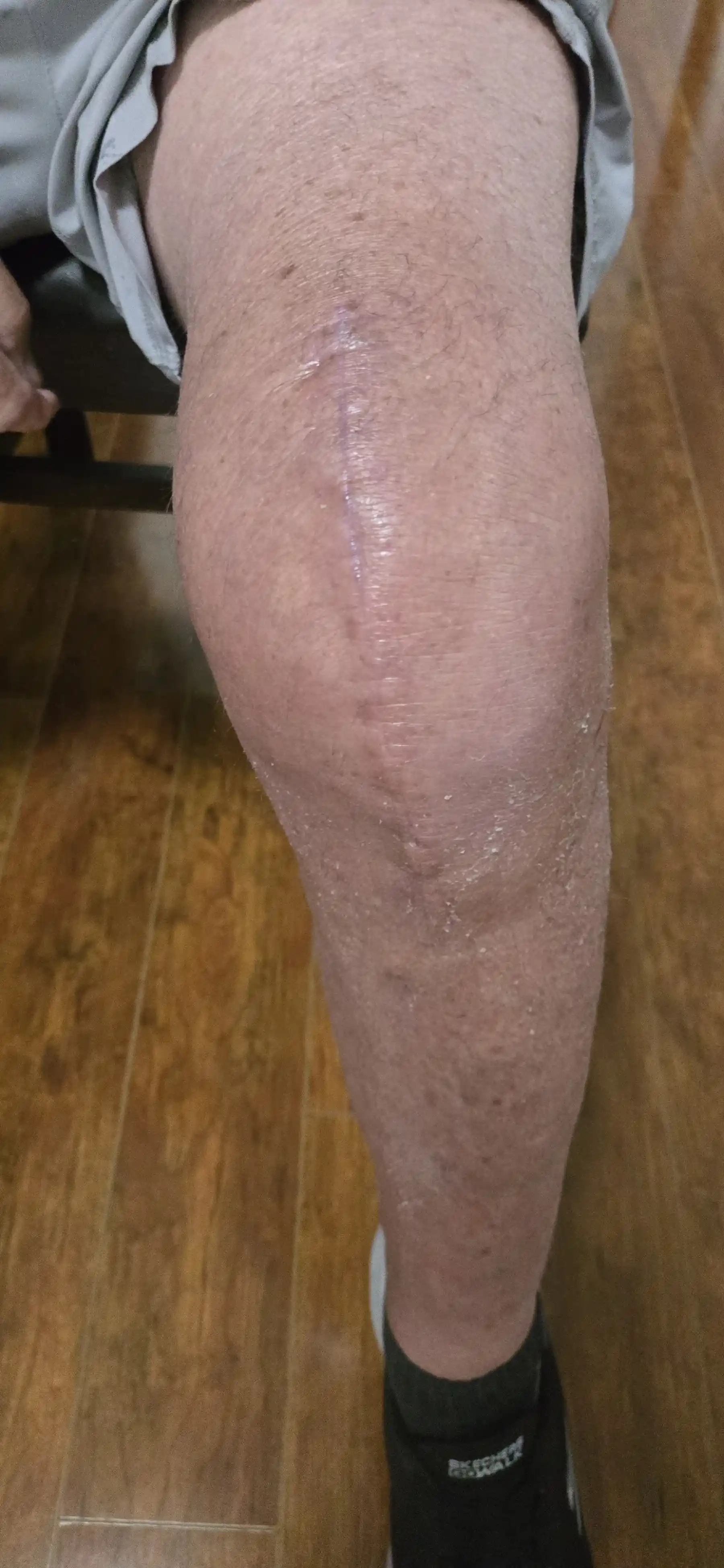
By five weeks, Dave was walking about 5,000 steps a day, keeping up with his physical therapy, and had regained 140 degrees of motion in his knee. His surgical scar looked great. He'd already picked up his putter again, working his way back toward a full round of golf.
Two Recoveries, One Family
Dave had spent months on the other side of this, sitting in waiting rooms while Margaret fought her own battle and won. When it finally became his turn to heal, she was there for that too, the same way he'd been there for her.

'We are so grateful to Dr. Redmond for his amazing skill and compassion, and for Mark, Erica, and all his staff as I have journeyed through this remarkable recovery.'
A limp that started in someone else's exam room turned into the start of Dave's own recovery, and now, with both of theirs behind them, Dave and Margaret have their health, and each other, back. If a limp, a cortisone shot that didn't quite do the job, or scans that keep getting worse sound familiar, Dave's story is a reminder that a clear diagnosis and the right surgical team can turn a long wait into a short recovery. Read more patient stories like Dave's, or request an appointment with Dr. Redmond at his Southside or Beaches office to talk through your own knee pain.
This blog is intended for general informational purposes. Any health-related information shared is not meant to provide or replace professional medical advice and does not establish a patient provider relationship. Individual outcomes vary. If you are experiencing a medical emergency, call 911 or go to the nearest emergency room.
